How will I be assessed? Grids, checklist and marking guide →
Film study · Overview
The Grizzlies · Film study
Why this film? Why at the end of the lesson?
This film study is Session 7 of our English unit Whose Land, Whose Water?, on Indigenous lands, dams and broken promises in Canada. It is a true story from Canada. In 1998, a young teacher from the south arrives in Kugluktuk, a small Inuit town in the Arctic. Life is hard for many teenagers there. He starts a lacrosse team with them.
The film brings together what you learned. In the unit, you discovered Indigenous lands in Canada, dams and the promises made to First Nations. Here, you meet the Inuit, their land and their language.
The film also shows the colonial past. For many years, Indigenous children were sent to residential schools, far from their families. Today, Canada tries to face this past: this is called reconciliation. But reconciliation is still far from finished. Many promises were made, especially under Prime Minister Justin Trudeau (2015 to 2025), but progress is slow. For example, some First Nations communities still cannot drink the water from their taps.
You will also hear English as a shared language. Inuit teenagers and a teacher from the south speak English together, but the Inuit keep their own language too.
Finally, the film ends on hope and teamwork. It is a good way to finish before the final task of the unit: you will speak about Indigenous lands, water and the promises made in Canada.
Clean water: a promise not kept yet
A drinking water advisory tells people: "Don't drink the water from your tap" or "Boil it first". It becomes long-term when it lasts more than one year.
In 2015, Justin Trudeau promised to end all long-term drinking water advisories on First Nations reserves within five years, by March 2021. The government did not keep this promise on time.
There is progress: 158 long-term advisories have been lifted since November 2015. But on 21 October 2026, 39 were still in effect in 37 communities.
In Neskantaga First Nation (Ontario, 374 people living on the reserve), people have had to boil their water since February 1995: more than 31 years, the longest advisory in Canada.
Discuss: 1. Is clean water a human right? Why? · 2. Canada is a rich country. Why is safe water still a problem in some First Nations communities? · 3. What should the government do now?
Sources: Indigenous Services Canada, Ending long-term drinking water advisories (figures as of 21 October 2026) · Indigenous Services Canada, Neskantaga First Nation · CBC News, December 2020: the minister admits the 2021 target will be missed
2. Many communities are very far from big cities, so building and repairing a water plant is slow and expensive (three to four years for a new plant). Some systems are old, and there are not enough trained workers. It is also a heritage of colonisation: for a long time, First Nations were not a priority.
3. The government should keep its promises, pay for new water plants and for trained workers, and let First Nations control their own water. Indigenous Services Canada itself says that First Nations' control of water is part of the solution.
L’eau potable, une promesse pas encore tenue. Un drinking water advisory est un avis qui demande de ne pas boire l’eau du robinet ou de la faire bouillir ; il devient « de longue durée » au bout d’un an. En 2015, Justin Trudeau a promis de supprimer tous ces avis de longue durée dans les réserves des Premières Nations en cinq ans, avant mars 2021 : la promesse n’a pas été tenue à temps. Il y a des progrès : 158 avis levés depuis novembre 2015, mais 39 étaient encore en vigueur dans 37 communautés au 21 octobre 2026. À Neskantaga (Ontario), il faut faire bouillir l’eau depuis février 1995, soit plus de 31 ans. Questions : l’eau potable est-elle un droit humain ? Pourquoi est-ce encore un problème dans un pays riche ? Que devrait faire le gouvernement ? Mots utiles : a human right (un droit humain), to boil (faire bouillir), a tap (un robinet), a water plant (une usine de traitement de l’eau), a promise (une promesse).
Encadré « Think! » sur l’eau potable : il nuance l’idée de réconciliation et relie le film à l’actualité. Axes du programme d’anglais (BO n° 22 du 29 mai 2025) : « Territoire et mémoire » en terminale (objet d’étude « Territoires autochtones : intégration, assimilation ou appropriation ? ») et « Diversité et inclusion » en première (« Représentation politique des Peuples premiers »). En voie professionnelle : thème « grandes problématiques d’actualité ». Chiffres vérifiés le 4 novembre 2026 sur le site de Services aux Autochtones Canada (page en français, données au 21 octobre 2026). Précision utile : ces chiffres concernent les réseaux publics des réserves des Premières Nations ; les communautés inuit du Nunavut, comme Kugluktuk, ne sont pas des réserves et ne sont pas comptées. Justin Trudeau a été Premier ministre de novembre 2015 au 14 mars 2025 (remplacé par Mark Carney). Les réponses modèles s’affichent avec « Answers ».
Why this film fits the programme
The Grizzlies (Miranda de Pencier, Canada, 2018) tells a true story: in Kugluktuk, in Nunavut, Inuit teenagers affected by a wave of suicides find pride and hope again through lacrosse. The film brings the colonial legacy (residential schools) into the classroom, as well as a reconciliation that is still unfinished; the box on drinking water adds nuance to this idea.
It fits the programme for the lycée général et technologique (BO n° 22 of 29 May 2025, annexe 4). In seconde: axe 3 « Le passé dans le présent » (the past in the present), with « Les commissions de réconciliation dans les pays anglophones : reconnaitre le passé pour mieux vivre ensemble » (reconciliation commissions in English-speaking countries: recognising the past to live better together). In première: axe 2 « Diversité et inclusion » (diversity and inclusion), with « Représentation politique des Peuples premiers : intégration ou appropriation ? » (political representation of First Peoples: integration or appropriation?), and axe 6 « Les aires anglophones américaines » (the English-speaking Americas). In terminale: axe 2 « Territoire et mémoire » (territory and memory), with « Territoires autochtones : intégration, assimilation ou appropriation ? » (Indigenous lands: integration, assimilation or appropriation?), and axe 3 « Fictions et réalités » (fiction and reality). In the voie professionnelle (BO spécial n° 5 of 11 April 2019), it covers the themes « grandes œuvres célèbres » (famous great works), « école, vie scolaire » (school and school life), « sports nationaux et équipes célèbres » (national sports and famous teams), « grands événements historiques, dates marquantes » (major historical events, key dates), « traditions, us et coutumes » (traditions and customs) and « grandes problématiques d’actualité » (major current issues). Target level: B1 to B2 in lycée général and bac pro, A2 to B1 in CAP, with the same tasks for everyone.
Our guiding idea: raise the level without scaring anyone. No watered-down content and no expectations out of reach: demanding content (colonial history, memory, film analysis), made accessible through clear steps, key vocabulary, sentence starters, model answers, help in French and an A2 / B1 assessment grid, so that everyone can grow in confidence.
| CEFR activity and skill | Where on this site |
|---|---|
| Listening | The official trailer in two viewings, then a third viewing for analysis (steps 2 and 3) |
| Reading | History timeline: residential schools, Nunavut, the Truth and Reconciliation Commission (step 2); box on drinking water (Start page) |
| Writing | Hypotheses (step 1); a film review or Miranda’s letter, 100 to 120 words (step 4) |
| Speaking (continuous) | A presentation of 4 to 5 minutes, useful practice for situation B of the bac pro (step 5) |
| Spoken interaction | Town meeting in Kugluktuk: role-play debate and a group decision (step 6) |
| Cultural and intercultural skills | The Inuit and Nunavut, Indigenous lands in Canada, lacrosse as a First Nations game |
| Film analysis | Shots, angles, light and music in the trailer (step 3) |
| Critical thinking and citizenship | Fiction and reality: who tells the story of a community? (step 3); drinking water and political promises (Start page); a group decision (step 6) |
A true story from the Canadian Arctic. In a small Inuit town, a young teacher and his students start a lacrosse team. You will study the film in six steps: before watching, watching, analysing, writing, speaking and debating.
Film card
| Title | The Grizzlies |
|---|---|
| Year | 2018 (first shown at the Toronto International Film Festival) · in Canadian cinemas in April 2019 |
| Director | Miranda de Pencier |
| Country | Canada |
| Where? | Kugluktuk, a small town in Nunavut, in the Canadian Arctic |
| Languages | English and Inuktitut |
| Genre | sports drama, based on a true story · about 1 h 45 |
| Main characters | Russ Sheppard, a young teacher from the south of Canada · Miranda, Zach, Adam, Kyle and Spring, Inuit students |
The story in simple English
In 1998, Russ Sheppard, a young history teacher from the south of Canada, arrives in Kugluktuk, a small Inuit town in the Arctic. Life is hard for many teenagers there: poverty, hunger, alcohol, violence at home, and too many young people who take their own lives.
Russ wants to help, but at first he does not understand the culture of his students. He decides to start a lacrosse team: the Grizzlies. Little by little, the students and their teacher learn from each other, and the team gives the whole town new pride and new hope.
Why it matters for Indigenous lands in Canada
The film shows the North of Canada, far from Ottawa and Toronto, and the heavy heritage of colonisation, like residential schools. It also gives a voice to Inuit people today: most actors are Indigenous, and Inuit producers worked on the film.
Your route
This film study is Session 7 of the English unit Whose Land, Whose Water? (première générale). Back to Whose Land, Whose Water?
The Grizzlies (Miranda de Pencier, Canada, 2018) raconte une histoire vraie : en 1998, un jeune professeur venu du sud du Canada arrive à Kugluktuk, petite ville inuite de l'Arctique (Nunavut). Beaucoup d'adolescents vont mal (pauvreté, alcool, violence, suicides). Il crée une équipe de crosse (lacrosse, sport inventé par les Premières Nations), les Grizzlies, qui redonne fierté et espoir à la communauté.
Les six étapes : 1. anticiper (titre, photos, vocabulaire, hypothèses) ; 2. comprendre la bande-annonce en deux visionnages (global puis détaillé) ; 3. analyser le langage du film (plans, angles, lumière, musique) ; 4. écrire une critique ou une lettre ; 5. présenter le film à l'oral pendant 4 à 5 minutes ; 6. débattre lors d'une réunion municipale.
Vocabulaire du cinéma : a close-up (gros plan), an extreme long shot (plan de grand ensemble), a high angle (plongée), a low angle (contre-plongée), a tracking shot (travelling), the soundtrack (bande-son). Histoire : les pensionnats autochtones (residential schools, jusqu'en 1996), les excuses du Premier ministre (2008), la Commission de vérité et réconciliation (2015). Si le sujet te touche, parles-en à un adulte de confiance ou appelle le 3114 (open, 24 h sur 24).
Niveau visé : B1 vers B2 en lycée général et en bac pro, A2 vers B1 en CAP, de la seconde à la terminale. Durée conseillée : 2 à 3 séances de 55 minutes, plus les exposés.
Déroulé suggéré : séance 1, présentation du film et étapes 1 et 2 (anticipation, bande-annonce en deux visionnages, contexte historique) ; séance 2, étapes 3 et 4 (analyse filmique, production écrite) ; séance 3, étape 6 (réunion municipale) et premiers exposés de l'étape 5, préparés à la maison.
Démarche : une étape par activité langagière du CECRL (compréhension de l'oral, production écrite, expression orale en continu, interaction orale), précédée d'une phase d'anticipation et complétée par une analyse filmique. Six encadrés « Pour le professeur » donnent les corrigés étape par étape.
Pourquoi ce film : The Grizzlies (Miranda de Pencier, Canada, 2018 ; sortie canadienne le 19 avril 2019, Mongrel Media) est peu exploité en classe, ancré au Canada, inspiré de faits réels (Russ Sheppard, Kugluktuk, 1998 · 1999) et coproduit par des Inuit (Alethea Arnaquq-Baril, Stacey Aglok MacDonald). Cette étude constitue la séance 7 de la séquence de première générale « Whose Land, Whose Water? », consacrée aux territoires autochtones, aux barrages et aux promesses non tenues au Canada.
Ancrage dans les programmes : programme d'anglais du lycée général et technologique, arrêté du 5 mai 2025, BO n° 22 du 29 mai 2025, annexe 4 (en vigueur en seconde depuis 2025, en première et terminale depuis la rentrée 2026).
• Seconde : axe 3 « Le passé dans le présent » (objet d'étude « Les commissions de réconciliation dans les pays anglophones »).
• Première : axe 2 « Diversité et inclusion » (objet d'étude « Représentation politique des Peuples premiers : intégration ou appropriation ? ») ; axe 6 « Les aires anglophones américaines » (le Canada).
• Terminale : axe 2 « Territoire et mémoire » (objet d'étude « Territoires autochtones : intégration, assimilation ou appropriation ? ») ; axe 3 « Fictions et réalités » (un film « tiré d'une histoire vraie », encadré « Think! » de l'étape 3).
• Voie professionnelle (CAP et baccalauréat professionnel) : programme de langues vivantes, BO spécial n° 5 du 11 avril 2019, thèmes d'étude « grandes œuvres célèbres (… cinéma …) », « école, vie scolaire », « sports nationaux et équipes célèbres », « grands événements historiques, dates marquantes », « traditions, us et coutumes ». La démarche par activités langagières (compréhension de l'oral, production écrite, expression orale en continu, interaction) prépare aux épreuves de CAP et de bac pro.
Sujet sensible, à lire avant la séance : le film montre trois suicides d'adolescents (aucun n'est montré de façon explicite, l'un est hors champ), des violences conjugales, de l'alcool et de la drogue chez des mineurs, un langage grossier. Classifications : PG dans la plupart des provinces canadiennes (Ontario, Colombie-Britannique, Alberta, Nunavut…), 14A au Manitoba, G au Québec ; R aux États-Unis (langage, alcool et drogue chez des adolescents) ; 15 ans et plus selon Common Sense Media ; aucune classification française trouvée. Conseils : travailler la bande-annonce (qui évoque un décès par « He's not coming back », sans image choquante) et la page en classe ; réserver un visionnage intégral à la première et à la terminale, après information des familles et en lien avec le CPE, l'infirmière ou le psyEN ; prévenir les élèves, ne jamais imposer ; rappeler le 3114. Le film se termine sur une note d'espoir. Ressources : fiche d'avertissement de Reel Canada (en anglais), Common Sense Media, 3114.fr.
Fleex : le film n'a pas de page Fleex (catalogue vérifié le 6 octobre 2026). Utiliser la bande-annonce officielle (Mongrel Media) et, pour des extraits, un support acquis légalement (DVD, VOD) dans le cadre de l'exception pédagogique. Alternative présente sur Fleex : Hunt for the Wilderpeople (Taika Waititi, Nouvelle-Zélande, 2016), plus léger. La séquence de Terminale construite autour de ce film est en ligne : Océanie anglophone · Hunt for the Wilderpeople.
Mode d'emploi : « Answers » affiche les réponses modèles, « + Français » ajoute une aide sous chaque étape, les exercices se corrigent avec « Check ». Les États-Unis sont volontairement laissés de côté.
Step 1 · Anticipation
Before watching
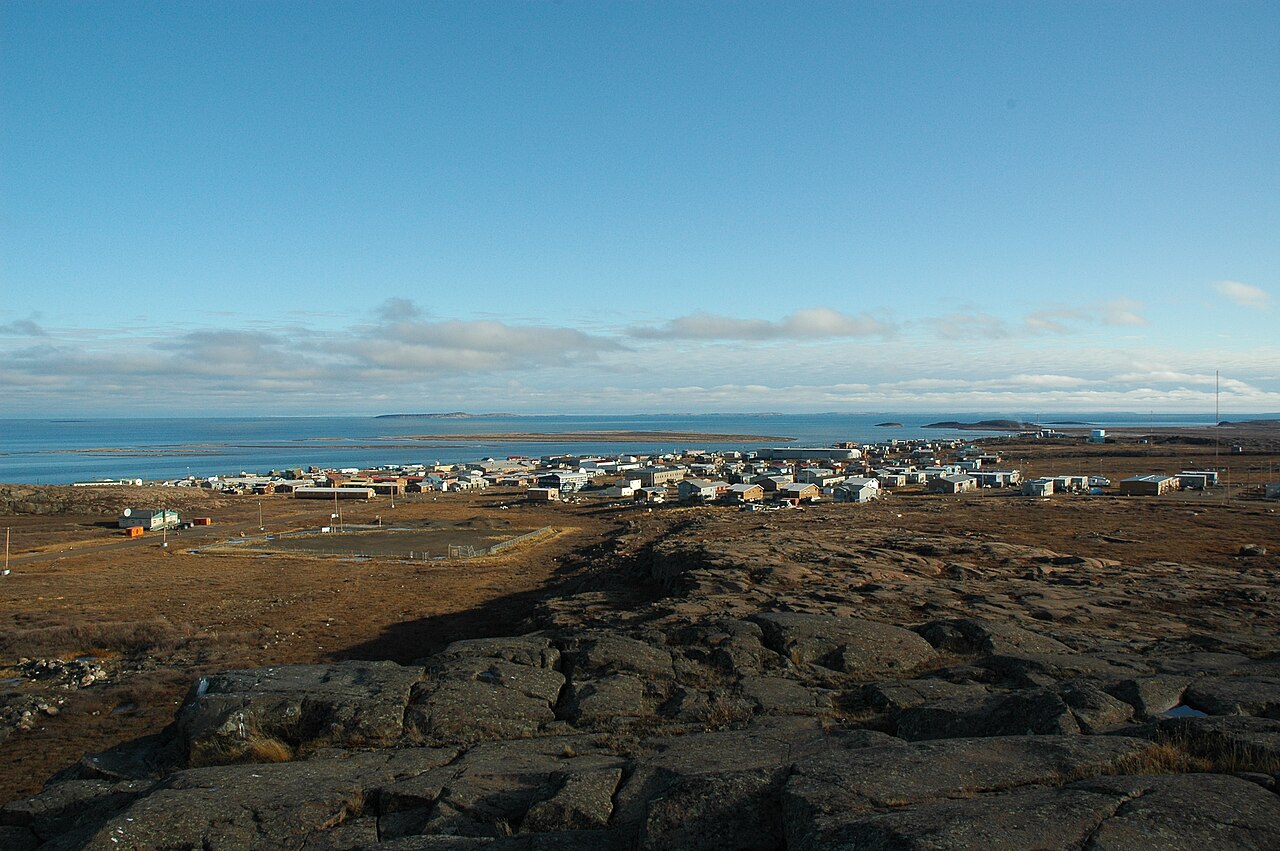
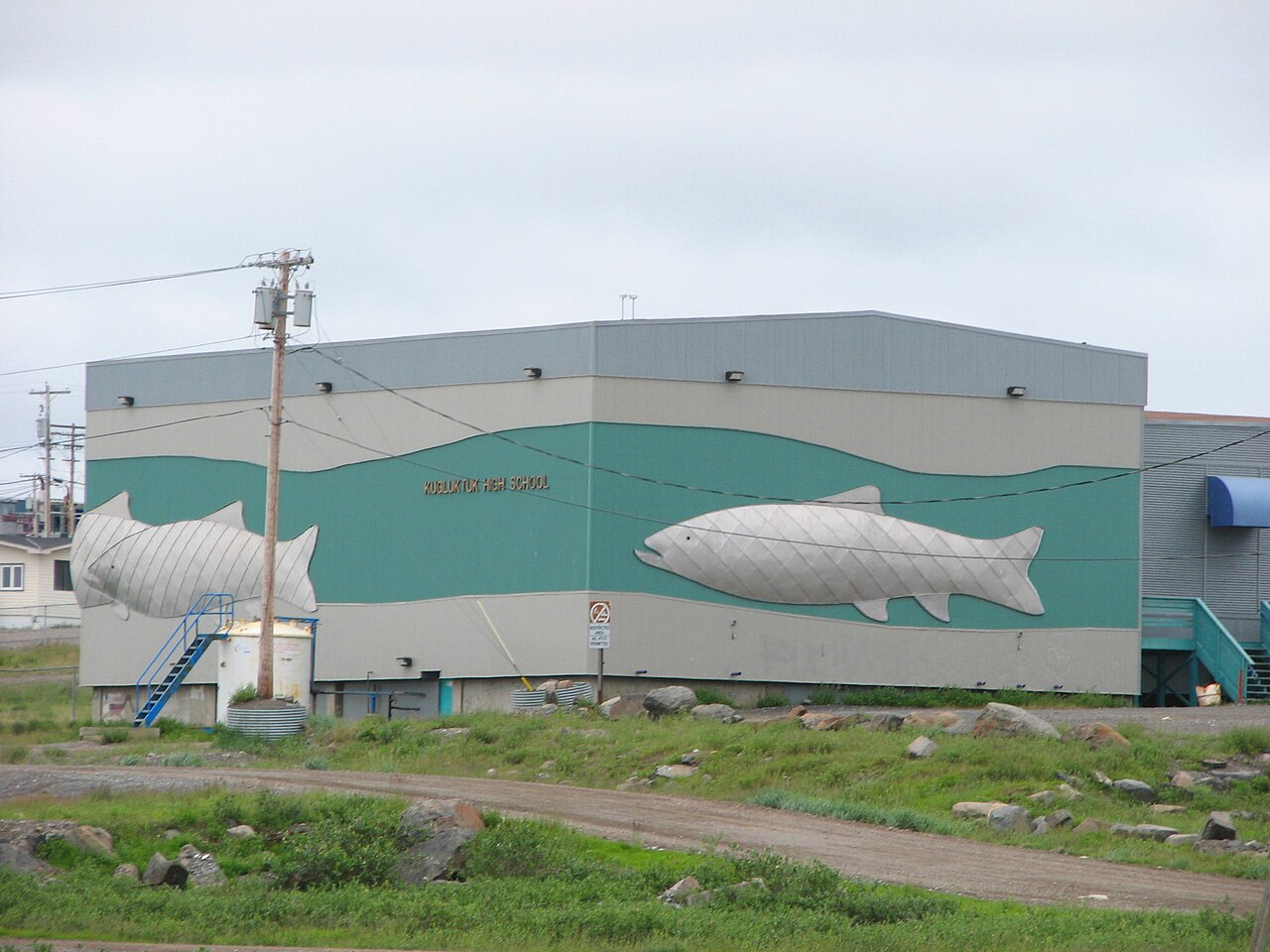
1. The title
A grizzly is a big brown bear. Why do you think a school team chooses this name?
2. The photos
Describe the two photos. What is life like in this town, in your opinion? Use there is / there are, it looks, I think.
Key vocabulary
| Word | Meaning |
|---|---|
| the Arctic · the North | the very cold region around the North Pole |
| the Inuit (people) · an Inuk (one person) | the Indigenous people of the Arctic |
| an elder | an old, respected person who passes on knowledge |
| to hunt · a hunter | to look for and kill animals for food |
| lacrosse · a stick · a goal | a team sport created by First Nations: you catch and throw a ball with a stick with a net |
| a coach · a teammate | the person who trains a team · a person in the same team |
| to drop out (of school) | to stop going to school |
| to struggle | to have great difficulties |
| pride · proud | a good feeling about who you are |
| a residential school · a survivor | a boarding school where Indigenous children were taken away from their families · a person who lived through it |
| to heal | to become well again, in your body or in your mind |
| to belong (to) | to feel part of a group |
Exercise 1 · Choose the right word
Hypotheses. Look at the title, the photos and the film card. Write three hypotheses about the film. Use I think... · Maybe... · I expect...
Avant de regarder : observe le titre (grizzly = grand ours brun) et les photos de Kugluktuk, apprends le vocabulaire clé (elder = ancien, to hunt = chasser, to drop out = décrocher de l'école, proud = fier, to belong = appartenir à un groupe) puis formule trois hypothèses avec I think, maybe, I expect.
Corrigé de l'exercice 1 : elders / hunt / coach / drop out / proud / belong. Les hypothèses seront vérifiées après la bande-annonce (étape 2). Durée indicative : 15 minutes.
Step 2 · Listening
The trailer in two viewings
The Grizzlies · official trailerMongrel Media (Canadian distributor) · about 2 min 20 · watch on YouTubeListening 1 · First viewing: the big picture
Who? Where? What? What is the problem?
Watch the whole trailer once. Note key words only, then choose.
Listening 2 · Second viewing: details
Listen carefully and complete what the characters say
React to the trailer. Choose one line from the trailer. Say who says it, to whom, and why it is important. I chose the line... It is said by... I think it is important because...
Background: the North, memory and a First Nations game
For thousands of years → the Inuit live in the Arctic. In the trailer, an Inuk says his people have lived there for "6,000 years".
From the 1880s to 1996 → residential schools: the Canadian government and churches take more than 150,000 First Nations, Inuit and Métis children away from their families. They are forbidden to speak their languages, and many suffer abuse. The last school closes in 1996.
1994 → lacrosse becomes Canada's national summer sport (ice hockey is the winter one). It was created by First Nations peoples long before Europeans arrived.
1996 → the town of Coppermine takes back its Inuit name: Kugluktuk, "the place of moving water".
1998 · 1999 → Russ Sheppard arrives in Kugluktuk as a teacher. In 1999, he starts the Grizzlies lacrosse team.
1 April 1999 → Nunavut ("our land" in Inuktitut) becomes a new Canadian territory, where most people are Inuit.
2008 · 2015 → the Prime Minister of Canada apologises for residential schools (2008). The Truth and Reconciliation Commission listens to survivors and publishes 94 "Calls to Action" (2015).
2018 · 2019 → The Grizzlies is released. Its song "Trials" wins a Canadian Screen Award.
Exercise 2 · True or false?
Premier visionnage : repère qui, où, quoi et le problème. Deuxième visionnage : complète les répliques exactes. Puis lis la frise : pensionnats autochtones (jusqu'en 1996), crosse inventée par les Premières Nations, création du Nunavut (1999), excuses du Premier ministre (2008), Commission de vérité et réconciliation (2015).
Corrigés : compréhension 1, in the Arctic / a new teacher / lacrosse / they do not trust him ; compréhension 2, kids / 6,000 / world / 21 / sports / Wednesday / hunt / game / hope / Grizzlies / running (réponses relevées sur les sous-titres de la bande-annonce officielle) ; exercice 2, false / true / false / true / true. Premier visionnage sans sous-titres, deuxième avec sous-titres anglais si besoin. La bande-annonce évoque un décès (« He's not coming back ») sans image choquante : prévenir la classe.
Step 3 · Film analysis
How does the film tell the story?
Film language toolbox
| English | En français | Effect on the viewer |
|---|---|---|
| an extreme long shot | un plan de grand ensemble | shows a huge landscape: people look small and isolated |
| a long shot | un plan d'ensemble | shows a character in a place |
| a medium shot | un plan taille | shows a person from the waist up: gestures, relations |
| a close-up | un gros plan | shows a face: we feel the character's emotions |
| an extreme close-up | un très gros plan | shows a detail: eyes, hands, a stick |
| a high angle | une plongée | the camera looks down: the character looks weak or alone |
| a low angle | une contre-plongée | the camera looks up: the character looks strong or powerful |
| a tracking shot | un travelling | the camera moves with the character: we follow the action |
| a pan | un panoramique | the camera turns: we discover a place |
| slow motion | le ralenti | makes a moment intense or emotional |
| cold / warm / dark / natural light | lumière froide, chaude, sombre, naturelle | creates a mood: sadness, danger, hope |
| the soundtrack · background music | la bande-son · la musique d'accompagnement | creates emotion and rhythm |
| a voice-over | une voix off | a voice tells or comments the story |
| fast editing · quick cuts | un montage rapide | creates energy or tension |
Exercise 3 · Name the technique
Analyse the trailer
Watch the trailer a third time. Watch the first minute without sound, then with sound. Answer with the toolbox words and say what the effect is: In this shot... This shows... As a result, the viewer feels...
a) The landscape. How is the Arctic filmed? What is the effect?
b) The faces. Which shots show the teenagers' feelings? Which feelings?
c) Light and colours. Compare the beginning and the end of the trailer.
d) Music and sound. How does the music change? What do the shouts add?
e) The effect on the viewer. What does the trailer want us to feel?
The film is "based on a true story". A film is not a documentary: what can a director change, and why? Who should tell the story of a community: people from inside or people from outside?
Utilise la boîte à outils : a close-up (gros plan), an extreme long shot (plan de grand ensemble), a high angle (plongée), a low angle (contre-plongée), a tracking shot (travelling), the soundtrack (bande-son). Pour chaque procédé, dis ce que tu vois puis l'effet produit : This shows that... As a result, the viewer feels...
Corrigé de l'exercice 3 : a close-up / an extreme long shot / a low angle / a high angle / fast editing / a tracking shot. Les réponses modèles de l'analyse décrivent la bande-annonce de façon générale : ajustez-les après votre propre visionnage. Troisième visionnage conseillé : la première minute sans le son, pour se concentrer sur l'image. L'encadré « Think! » relève de l'axe « Fictions et réalités » (terminale).
Step 4 · Writing
A review or a letter
A. A film review (100 to 120 words)
Write a review of The Grizzlies for your school website or the ENT. Give: the title, the director and the country · the story in two sentences · one film technique from the trailer and its effect · your opinion with because and however · your recommendation.
B. A character's letter (100 to 120 words)
You are Miranda. Ten years later, you write a letter to Russ, your old teacher. Say what you remember, what the team changed for you and for the town, and what you do today.
Ten years ago, you arrived in Kugluktuk and you didn't understand us. We didn't trust you either! But you listened, and you learnt from our elders. I still remember our first practice in the gym and our long trip to Toronto. The whole town was proud of us. Thanks to the team, I stayed at school and I didn't give up. Today I am a nurse at the health centre, and I coach the young Grizzlies on Wednesdays. The kids are proud to be Inuit and proud to play.
Thank you for staying.
Miranda
Checklist before you hand in
☐ I use the past simple for finished events (arrived, started, lost).
☐ I use at least four words from the vocabulary box.
☐ I use one film word from the toolbox (review) or one feeling (letter).
☐ I link my ideas with because, so, but, however, although.
☐ I write between 100 and 120 words.
Choisis : une critique du film (titre, réalisatrice, histoire, un procédé filmique, ton avis, ta recommandation) ou la lettre de Miranda à son ancien professeur. Entre 100 et 120 mots, au prétérit pour les faits passés, avec des connecteurs.
Production écrite : possible sur un document à compléter (papier ou ENT). Critères suggérés (sur 10) : respect de la consigne et de la longueur 2 points ; contenu (faits exacts, procédé filmique ou sentiments) 3 points ; lexique 2 points ; grammaire (prétérit, connecteurs) 3 points. La lettre de Miranda ne dévoile pas la fin du film.
Step 5 · Speaking
A 4 to 5 minute presentation
Your task: present The Grizzlies to the class and explain what it shows about Canada and the Inuit. Speak for 4 to 5 minutes, from notes (key words only, never full sentences). Show one image: a photo of Kugluktuk or a frame from the trailer.
Your outline
| Part | Time | What to say | Useful language |
|---|---|---|---|
| 1. Introduction | 30 s | A hook (a line from the trailer), then the title, director, year, country. Announce your plan. | "Welcome to the edge of the world." This is how... Today I'm going to present... First... then... finally... |
| 2. The place and the people | 45 s to 1 min | Kugluktuk, Nunavut, the Arctic, about 1,400 people, the Inuit. Describe your image. | It is located in... It is home to... In this photo we can see... It looks... |
| 3. The story and the characters | 45 s to 1 min | Russ and two students of your choice (Miranda, Zach, Adam, Kyle). The problem, the idea of the team. Don't tell the end! | At the beginning... Then... He decides to... She wants to... but... |
| 4. Film analysis | 1 min | Two examples from the trailer: one shot (extreme long shot, close-up, low angle...) and the music or the light. Give the effect each time. | In this shot, the camera... This shows that... As a result, the viewer feels... |
| 5. History and memory | 45 s to 1 min | Residential schools, the 2008 apology, the Truth and Reconciliation Commission, lacrosse as a First Nations game. | The film reminds us that... For more than a century... Although... Today... |
| 6. Opinion and conclusion | 30 to 45 s | Your opinion, one limit, a recommendation and a question to the class. | In my opinion... However... To sum up... I would recommend it because... What do you think: can a sport heal a town? |
Total: 4 to 5 minutes. Practise with a timer at home. If you are under 4 minutes, add one more example in part 4 or part 5.
Connectors for a clear presentation
Part 4: In the first shot, the camera shows the frozen land in an extreme long shot. The town looks tiny, so we understand that it is very isolated. Moreover, at the end of the trailer, there are close-ups on the players' faces and the music becomes faster, with drums. As a result, the viewer feels the energy and the pride of the team.
Conclusion: To sum up, The Grizzlies is not only a sports film. It shows the wounds of colonisation, but also the strength of the Inuit. In my opinion, it is a moving film. However, some scenes are hard, so I would recommend it to people over fifteen. What do you think: can a sport heal a town?
Evaluation grid (out of 20)
| Criteria | Points | A2: I can... | B1: I can... |
|---|---|---|---|
| Length and independence | /3 | speak for 3 minutes, reading my notes often | speak for 4 to 5 minutes from key words, looking at the class |
| Cultural content | /4 | give basic facts on the place and the story | give exact facts on Kugluktuk, the Inuit, residential schools and the Truth and Reconciliation Commission |
| Organisation | /3 | follow some parts of the outline with first, then | announce my plan, follow the six parts and use varied connectors |
| Film analysis | /3 | name one technique | analyse two techniques (shot, angle, light or music) and explain their effect |
| Vocabulary | /3 | use some words from the page | use six words from the vocabulary box and three film words |
| Grammar | /2 | use simple sentences in the present | use the present, the past simple and the passive (was released, was created) mostly correctly |
| Pronunciation and fluency | /2 | be understood with some effort | speak clearly, with few hesitations and good word stress (Inuit, Arctic, lacrosse) |
Exposé de 4 à 5 minutes en six parties : introduction, le lieu et les habitants, l'histoire et les personnages (sans dévoiler la fin), l'analyse de deux procédés de la bande-annonce, l'histoire et la mémoire (pensionnats, réconciliation), ton avis et ta conclusion. Parle à partir de mots-clés, jamais de phrases rédigées.
Expression orale en continu : préparation à la maison, passage sur la séance suivante (4 à 5 exposés par heure). La grille sur 20 distingue A2 et B1 pour chaque critère ; elle peut être donnée aux élèves dès le départ pour l'auto-évaluation. En voie professionnelle, l'exposé prépare à la prise de parole en continu des épreuves de CAP et de bac pro.
Step 6 · Interaction
A town meeting in Kugluktuk
The question: "Should the school in Kugluktuk follow the Inuit way of life (hunting seasons, Inuit language, elders in class), or the same rules as schools in the South?"
You are at a town meeting in Kugluktuk. In groups of six, each student takes a role card, prepares two arguments (5 minutes), then the meeting starts. The mayor (or your teacher) leads the meeting. At the end, the group must agree on one decision.
Role cards
• Russ, the teacher: school and sport give the kids a future. He wants them to come every day.
• Adam's grandmother, an elder: she remembers residential schools. Hunting is food, culture and freedom.
• Miranda, a student: she wants to go to college one day, and to stay Inuit.
• Zach, a student: his family is hungry. When there are caribou, he must hunt.
• The principal: she must follow the official programme, but she respects the community.
• A town councillor: money is short. What is best for jobs and for the future of the town?
Useful language for interaction
Asking: What do you mean by...? · Can you give an example? · Why do you think so?
Agreeing: I agree with you. · That's a good point. · Exactly!
Disagreeing politely: I see what you mean, but... · I'm not sure about that, because...
Interrupting: Sorry to interrupt, but... · Can I say something?
Finding a compromise: What if we...? · Why don't we...? · Let's agree on...
Grandmother: When I was a child, they took me to a residential school. I lost my language. I don't want that for Adam.
Russ: I understand, but school is not the same today. Adam is good at maths, and the team needs him.
Zach: Sorry to interrupt, but when my family is hungry, I can't sit in class. Hunting comes first.
Miranda: What if the school followed the hunting seasons, with lessons on the land with the elders?
Principal: That's a good point. We could invite elders to teach Inuinnaqtun twice a week.
Councillor: Let's agree on this: a school calendar adapted to the hunting seasons, elders in class, and the lacrosse team for everybody.
In the trailer, someone asks the teacher who he is to say what the community needs. After residential schools, why is it important that Indigenous peoples decide for themselves? Is there a similar debate in another English-speaking country?
Going further: the real Grizzlies
• The healing power of the game of lacrosse · CBC Archives, 2002, 8 min: the real team, twenty years before the film.
• The Grizzlies lacrosse team is still going strong · CBC article: elders and kids make lacrosse sticks together.
• Lacrosse Talks: Russ Sheppard · the real teacher tells how the team was born (YouTube).
Réunion municipale : chacun joue un rôle (le professeur, une ancienne, deux élèves, la principale, un conseiller municipal), prépare deux arguments, puis le groupe doit se mettre d'accord sur une décision. Utilise les expressions pour demander, être d'accord, contester poliment, interrompre et trouver un compromis.
Interaction orale : groupes de six, 5 minutes de préparation, 10 minutes de réunion, 5 minutes de restitution (chaque groupe annonce sa décision). Évaluer la capacité à réagir, à demander des précisions et à proposer un compromis. Lien avec les axes « Diversité et inclusion » (première) et « Territoire et mémoire » (terminale) : qui décide pour les peuples autochtones ?
Next: English-speaking Oceania
Terminale · Hunt for the Wilderpeople (Taika Waititi, 2016): the Treaty of Waitangi, child welfare, New Zealand accents, in 9 sessions →